

How AI Lip-Sync Translation Changed Global Ad Campaigns
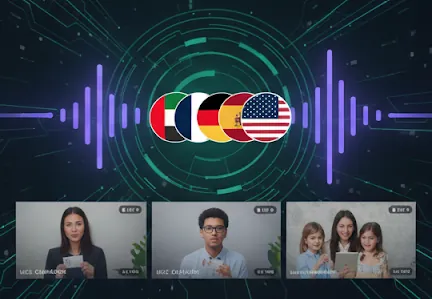
A brand used to choose between two bad options for international video: run the home-market ad with subtitles and accept weaker performance, or re-shoot per market and accept the cost. Dubbing sat awkwardly in between — cheaper than a re-shoot, but obvious enough that viewers discounted it.
AI lip-sync translation removes that trade-off. The same footage can now speak Japanese, Portuguese, German and Hindi with the original speaker's voice and mouth movements that match the new language. What changes is not just the production budget; it is which markets are worth testing at all.

Why Dubbed Audio Alone Stopped Being Enough
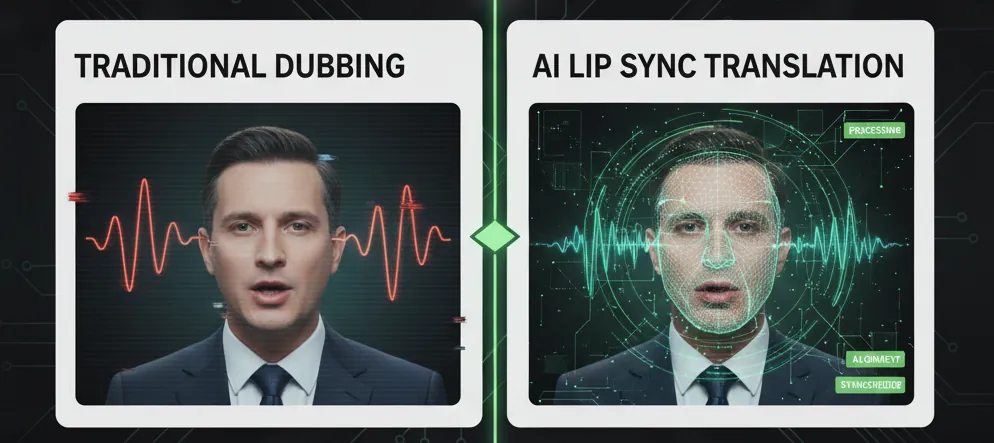
Conventional dubbing replaces the audio track and leaves the picture untouched. On voiceover-driven content, nobody notices. On face-to-camera advertising — the format that dominates paid social — the mismatch between sound and mouth is visible within a second or two.
Viewers rarely articulate the problem. They just find the ad slightly less credible, scroll a little sooner, and the creative underperforms for reasons that never show up in a report. For UGC and testimonial formats the damage is worse, because authenticity is the entire proposition. A creator whose lips do not match their words is no longer a person recommending a product; they are a translated asset.
Lip-sync closes that gap by editing the mouth region of the video to match the translated audio, frame by frame. Done well, the result reads as originally-shot footage.
What Actually Happens Under the Hood
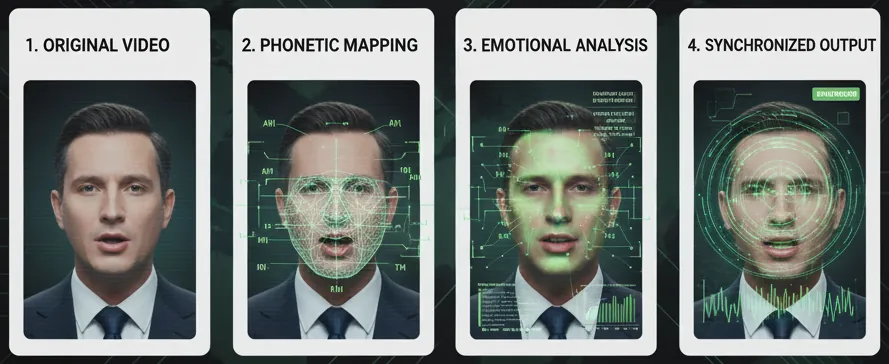
A modern localization pipeline runs four distinct jobs, and each can fail independently.
Transcription and speaker separation. The system transcribes the source audio and identifies who is speaking when. Multi-speaker detection matters here: two people in a testimonial need two voice profiles, not one averaged voice.
Contextual translation. Marketing language does not survive literal translation. The script is translated as a whole, with brand terms, product names and claims held fixed by a glossary rather than re-interpreted per sentence.
Voice cloning. The system builds a voice profile from the original speaker — timbre, pace, emphasis, pause patterns — and renders the translated script in that voice. Good output preserves emotional delivery: a line that was warm stays warm, a punchline still lands as a punchline.
Lip-sync. Finally, mouth movement is regenerated to match the new phonemes while the rest of the frame is left alone. The hard parts are fast speech, strong expressions, partial occlusion when a hand or a product crosses the face, and profile angles. Occlusion handling is a reasonable proxy for how mature a lip-sync system is.

What Changes for Campaign Planning
Speed changes what you can react to
Traditional localization workflows run in weeks: casting, recording, editing, review, delivery. AI localization runs in minutes to hours. The strategic consequence is not "we save time" — it is that reactive campaigns become possible in every market at once instead of only the home market. A trend, a competitor move or a seasonal window can be answered in ten languages the same week.
Testing replaces guessing
When a localized variant costs a fraction of a re-shoot, the sensible strategy changes. Instead of committing to two markets after a research exercise, you localize your best creative into six, run them at equal budgets for a week or two, and let CPA decide where the budget goes next. Localization becomes a testable channel rather than a fixed bet.
The unit of work becomes the variant, not the video
Campaign-scale localization means one proven creative times several languages times a few hook variations. That is dozens of files, which is why bulk upload and consistent terminology across a batch matter more in practice than any single quality metric.
The Cost Comparison That Matters
Traditional localization is billed per language per video: voice talent, studio time, editing and sync, plus project management on top. Quotes vary widely by market and agency, but the structure is always linear — the fifth language costs roughly what the first one did.
AI localization inverts that. You buy capacity in the tens to low hundreds of euros per month, and there is no per-language surcharge — a minute of output draws the same tokens in any language. For a brand running one flagship ad in one market, the savings are pleasant. For a brand running twelve creatives across eight markets, the difference decides whether the program exists.
The cost that people forget to model is review. Whatever the tool, someone should check terminology and claims before the batch renders — ideally a native speaker on the first few videos per market, and thereafter only when the creative changes materially.
Measuring Whether It Worked
Localization is measurable in the same places your ads already are; you do not need a separate analytics stack, and you should be suspicious of any tool that claims to provide one.
- View-through and hold rates per language. The clearest early signal that a localized version reads as native rather than dubbed.
- CPA and ROAS by market, not blended. Blended numbers hide the market that is subsidising the rest.
- Creative-level comparison. Same creative, subtitled versus dubbed versus lip-synced, at equal budget. This is the only comparison that tells you whether lip-sync is worth its cost for your format.
- Qualitative check. Ask a native speaker whether the ad sounds like a person or a translation. It catches problems no metric will.

Where Lip-Sync Pays Off, and Where It Does Not
Worth it: talking-head ads, creator and UGC content, founder and testimonial videos, product demos where a presenter is on camera. Anywhere a human face is delivering the message, lip-sync carries the credibility.
Not worth it: voiceover-driven product montages, screen recordings, animation, and any format where no mouth is visible. Dubbing alone is cheaper and the result is identical.
That distinction is worth applying per asset rather than per campaign — most brands have a mix, and paying for lip-sync on a montage is money spent on nothing.
Choosing a Platform
The features that separate serious tools from demos are unglamorous: voice cloning that holds up across a long script, lip-sync that survives occlusion and profile angles, glossary control so a product name is never "translated", multi-speaker handling, subtitle styling that survives vertical crops, and a review step before rendering.
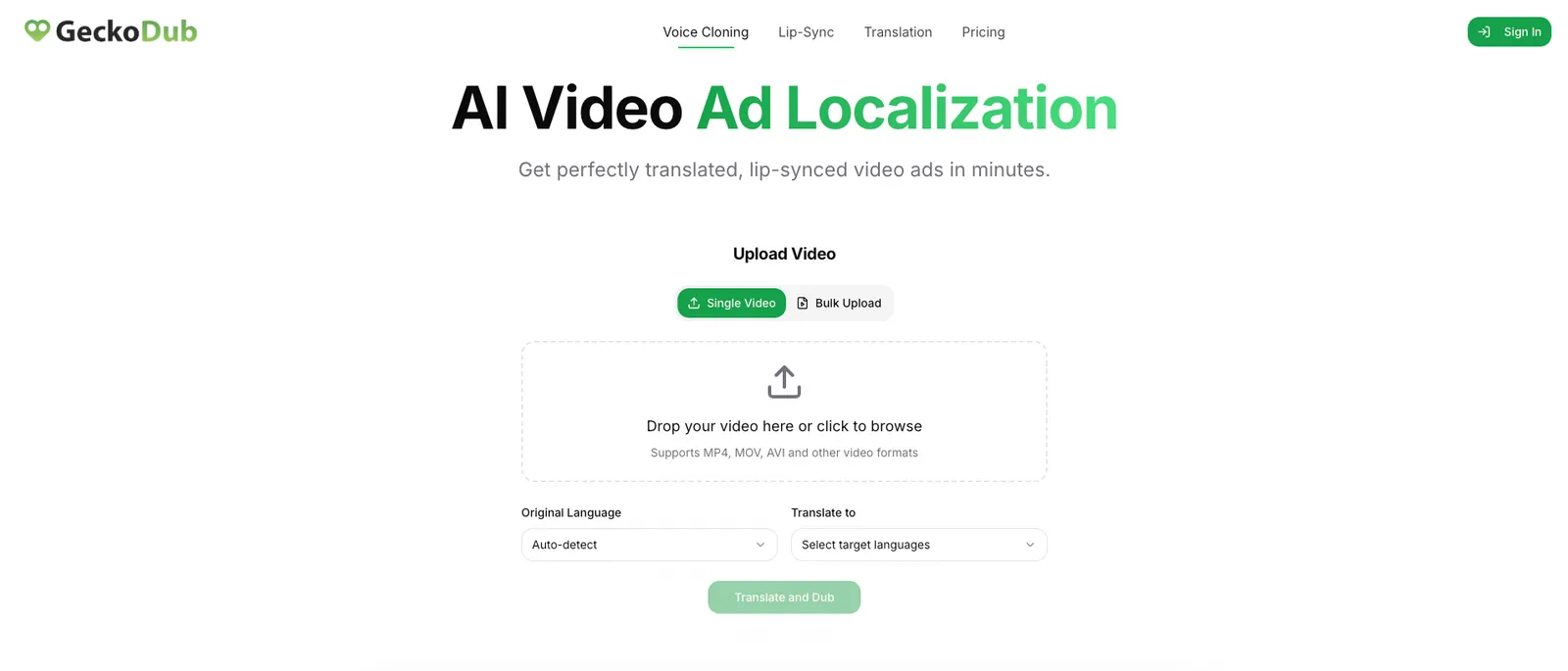
GeckoDub was built for exactly this workflow — voice cloning, GoSync lip-sync, animated subtitles and glossary-controlled translation across 70+ languages, with bulk upload for campaign-scale batches and voice data handled by an EU company on EU cloud hosting, with GDPR as the home regime. Plans start at €25/month and there is a free trial, so the fastest way to judge output quality is on your own footage rather than on a demo reel. See pricing for current details.
The Takeaway
Lip-sync translation did not just make localization cheaper. It made localized video good enough that the localized version competes with the original on its own terms — which means the constraint on international expansion is no longer production capacity but market selection.
The brands pulling ahead are not the ones with the biggest localization budgets. They are the ones treating every market as a test they can afford to run.
Ready to hear your own ad in another language? Try GeckoDub free and localize your first video today. If you are weighing the ethics of synthetic voice along the way, our guide to the ethics of AI voices is a good next read.
Ready to go global?
Translate your videos into 70+ languages with AI-powered dubbing that sounds natural.
Try GeckoDub free →