

The Ethics of AI Voices: What You Need to Know in 2025
Voice cloning stopped being a demo and became a line item. A usable clone can now be built from a short sample, which means any agency can re-voice a testimonial into eight languages before lunch — and any agency can also, without meaning to, clone a voice it has no right to use, in a market where that carries a fine.
The technical barrier has fallen. The ethical and legal one has not, and it is moving in the opposite direction: consent, disclosure, and cultural judgement are becoming enforceable obligations rather than good manners. This is what agencies and small businesses localising ads need to have straight.
The three questions that matter
Most AI voice problems reduce to three questions, asked before the campaign rather than after.
1. Do you have the right to this voice?
Under GDPR, a recording of someone's voice is personal data. When it is processed specifically to identify that individual, it becomes biometric data — a special category with a higher bar. Voice cloning for dubbing does not always meet that definition, but it does not need to for you to have a problem: you still need a lawful basis to process the recording, and outside data protection law you are also dealing with personality, likeness, and performers' rights, which vary by country and do not disappear because a model generated the output.
In practice, documented consent is the only defensible position for commercial work. Three things to capture in writing:
- Scope — what the voice may be used for, in which territories, for how long, and in which languages.
- Revocation — how the speaker withdraws consent, and what happens to derived assets when they do.
- Compensation — what the speaker is paid when their voice is cloned for commercial use, separate from the original recording fee.
This applies as much to your own staff and UGC creators as to hired talent. "They filmed it for us" is not consent to clone them.
GeckoDub's voice cloning is consent-based: you confirm you hold the rights to the voice you are cloning before it is used. That confirmation is a prompt, not a legal opinion — the underlying paperwork with your talent is still yours to hold.
2. Are you telling people?
The EU AI Act's Article 50 makes disclosure a legal requirement, not a courtesy. From August 2026, deployers of AI systems that generate or manipulate audio, image, or video content resembling real people must disclose that the content is artificially generated or manipulated. Providers of such systems must also mark their output in a machine-readable format so it can be detected downstream. Penalties for breaching the transparency obligations reach €15 million or 3% of worldwide annual turnover, whichever is higher.
Two nuances worth knowing. The obligation attaches to content that looks or sounds like a real person even where no deception was intended. And the exact application date has been subject to legislative adjustment — confirm the current deadline before you build a compliance plan around it. The official Article 50 text is the reference point.
Practically, disclosure means labelling AI-voiced ads in a way a viewer would actually notice, and being able to explain on request how a given asset was produced. Brands that get caught concealing it lose more than the fine.
3. Does it land in the target culture?
Technical accuracy is not the same as cultural fit. A warm, casual read that performs in the US can register as unprofessional in Germany. A lip-synced UGC ad that feels authentic in one market can sit in the uncanny valley in another. Register, formality, and pacing are localisation decisions, not translation decisions — and they are where automated pipelines most need a native reviewer.
The tools help: GeckoDub's translation step is editable before any audio is generated, so tone and terminology can be corrected by someone who knows the market rather than discovered in the comments.
The regulatory patchwork
Rules differ enough that a campaign which is compliant in one market can be unlawful in another.
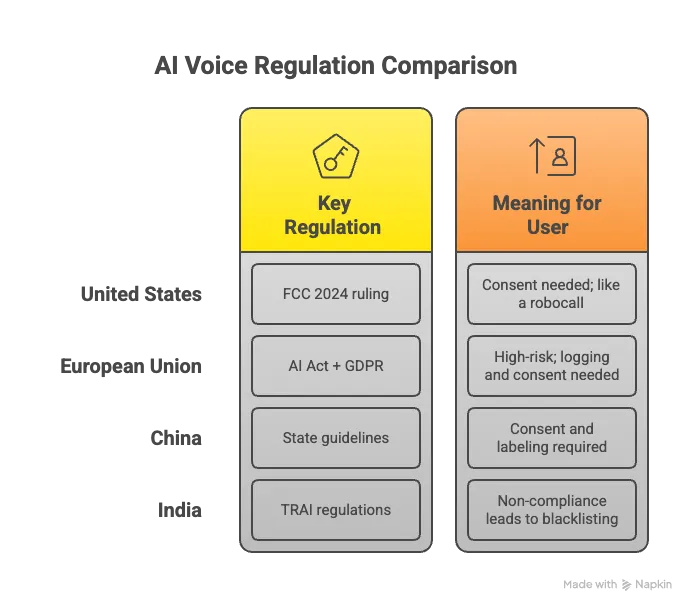
Broadly: the EU combines GDPR obligations on personal and biometric data with the AI Act's transparency duties. The US has no single federal rule but a growing patchwork of state laws on digital replicas and rights of publicity, plus federal enforcement against AI-enabled impersonation. China requires conspicuous labelling of synthetically generated content. The UK has no AI-specific statute for this, relying on UK GDPR and advertising standards.
The practical takeaway is not to memorise any of it. It is to assume that disclosure and documented consent are required everywhere you advertise, because that posture is compliant in the strictest market and harmless in the loosest.
Why doing this properly is also the commercial answer
Ethical AI voice work is cheaper than it looks and the alternative is more expensive than it looks.
Cloning removes the single largest cost in multilingual voiceover — per-language talent and studio time — which is why localisation budgets that used to cover two markets now cover eight. Consistency compounds the effect: the same brand voice across every language is worth more than eight competent but unrelated voices.
Against that, the downside is asymmetric. A consent dispute with talent, a regulator's transparency finding, or a viral thread about a brand hiding synthetic voices all cost more than the localisation programme saved — and they land after you have already scaled the asset across markets.
Safeguards worth putting in place
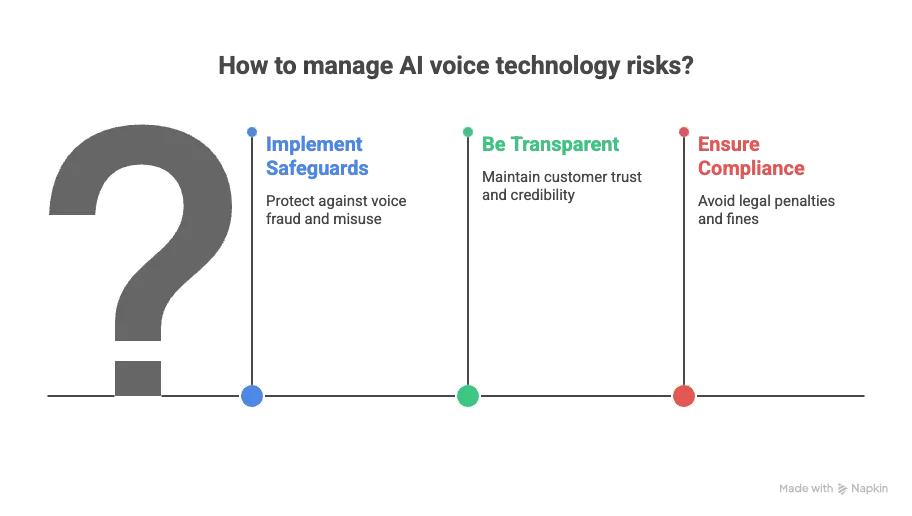
Technical. Keep an audit trail of which assets were AI-generated, from which source recording, under which consent record. Restrict who can create clones. Prefer platforms that mark synthetic output — machine-readable marking is heading toward being mandatory anyway.
Operational. Write down your own rules on when cloning is and is not acceptable. Review compliance periodically rather than at launch. Train the people making the ads, not just the person who signed the contract. Respeecher and Synthesia both publish usable ethical frameworks worth reading before writing your own.
Contractual. Region-specific consent templates. One global form will be too weak somewhere and unnecessarily broad somewhere else.
Where this is heading
Expect transparency requirements to tighten rather than relax, penalties to become real rather than theoretical, and audience awareness to rise — which is the change that matters most. As viewers get better at recognising synthetic voices, undisclosed cloning stops being a legal risk and starts being a credibility one.
The question for agencies is no longer whether to use AI voices. It is whether your consent paperwork, disclosure practice, and cultural review would survive being looked at. Build that now, while it is a competitive advantage, rather than in 2026 when it is the minimum.
Ready to go global?
Translate your videos into 70+ languages with consent-based voice cloning that keeps your speaker's voice.
Try GeckoDub free →