

AI Dubbing vs Traditional Localization: The ROI Math for Ad Teams
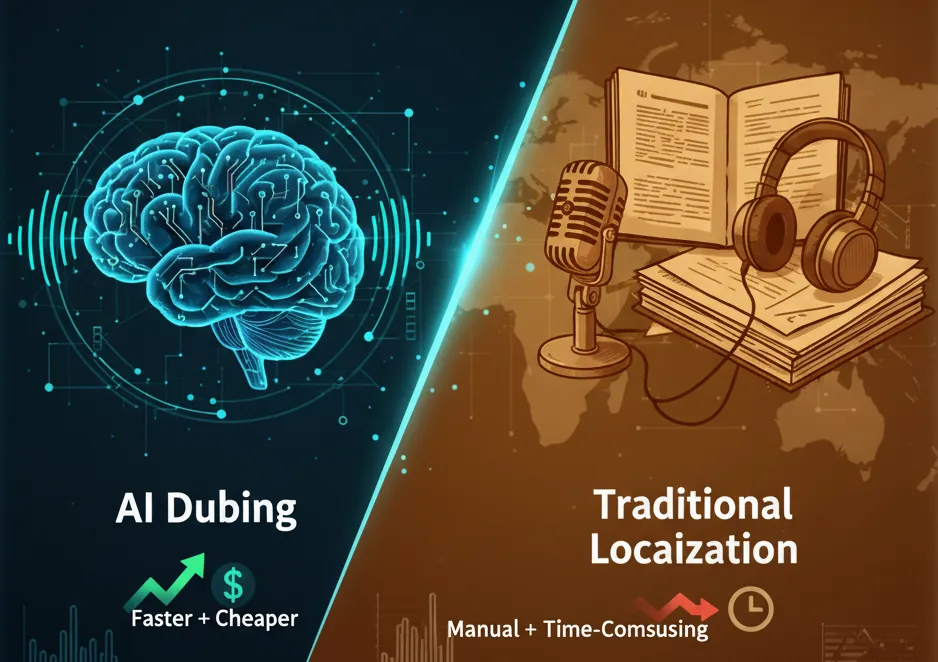
Every ad team expanding into new markets eventually has to answer a budget question, not a technology one: how much of your localization spend should go to humans, and how much to AI?
Traditional localization is a full stack of human work — script adaptation, cultural consulting, casting, studio recording, post-production, native QA. AI dubbing collapses most of that stack into a subscription. The interesting question isn't which one is "better" in the abstract. It's which one earns a better return on investment for each type of asset in your campaign, and how to split a fixed budget between them.
This guide is written for agencies and small businesses making that allocation decision: what each approach really costs, where each one earns its keep, and how to build a hybrid workflow that doesn't overpay for nuance you don't need. I'll also share what happened when I ran a real UGC ad through GeckoDub.
Just comparing voice work? If your question is narrower — AI voice cloning versus hiring voice actors for the same script — see AI dubbing vs traditional dubbing for ads, which goes factor by factor on cost, speed, and lip-sync.
What Is Traditional Localization?
How It Works
Traditional localization involves multiple human experts:
-
Translators adapt scripts to fit cultural context.
-
Casting directors find voice actors.
-
Recording engineers handle studio sessions.
-
Post-production teams sync audio and video.
Crucially, this is more than dubbing. You're buying cultural adaptation — the judgment call that a joke won't land in Germany, that a claim needs different framing in Japan, that your CTA reads as pushy in Dutch. That judgment is the part AI is genuinely weakest at.
Cost and Timeline
Traditional dubbing typically runs $50–$300 per minute, so a substantial campaign can reach four to five figures per language. Timelines are also lengthy — commonly 4 to 6 weeks from brief to delivery.
For brands that thrive on quick, seasonal promotions, this lag can mean missed opportunities. By the time a Black Friday creative is localized, Black Friday is over.
Where It Excels
-
Luxury brands, where emotion and nuance matter.
-
Campaigns where brand voice authenticity is critical.
-
Markets with strong cultural sensitivities.
What Is AI Dubbing?
How It Works
AI dubbing combines:
-
Voice cloning (replicating original voices).
-
Automated translation (with context awareness).
-
Lip-sync technology (making speech match visuals).
This lets brands scale localization fast, with one cloned voice used across multiple languages.
Cost and Timeline
AI dubbing is dramatically cheaper, and it prices differently: instead of paying per minute per language, you pay a flat monthly subscription. GeckoDub's plans run from €25/mo to €199/mo, covering roughly 13 to 155 minutes of video translation — across any of 70+ languages, not per language. That single pricing difference is what changes the ROI calculation, because your cost stops scaling with the number of markets you enter.
Timelines shrink from weeks to minutes. A campaign that would have taken a month to localize can go live the same afternoon.
Where It Excels
-
E-commerce product videos.
-
Explainer videos or tutorials.
-
UGC-style social ads where speed and scale matter.
Real-World ROI Comparison
Here's a side-by-side view of traditional vs AI localization:

ROI Beyond Cost: Why Localized Ads Perform Better
Localization isn't only about saving money — it's about improving ad performance. The consistent finding across industry research on multilingual marketing is directional and worth internalising:
-
Localized campaigns meaningfully outperform English-only campaigns on click-through and conversion in non-English-speaking markets.
-
Consumers are more likely to buy when the buying experience is in their own language, and that preference holds even among people who speak English well.
-
Content in the local language earns higher organic engagement than generic global content, and platform algorithms reinforce that gap by favouring language-matched content in the feed.
The size of the lift varies enormously by market, category, and how well the localization is done — treat published percentages as evidence of direction, not as forecasts for your account. What's not in dispute is the sign of the effect.
This is where AI dubbing compounds: it doesn't just make each localized asset cheaper, it makes launching sooner possible, which is how you capture seasonal peaks and trending moments instead of arriving after them.
My Experience Using GeckoDub
I tested GeckoDub to localize a user-generated content (UGC) ad originally recorded in English. The tool handled three things impressively well:
-
Voice cloning: It replicated the original speaker's voice closely enough that the energy of the original read survived the translation.
-
Lip-syncing: The dubbed speech matched the mouth movements well enough that it looked like the person was speaking the target language.
-
Natural feel: Unlike many AI tools that sound robotic, the final video felt authentic — no obvious tells that it was voice-cloned.
For a small business producing social ads, this changes what's affordable. What would have taken weeks and thousands of dollars was ready in a day, at a fraction of the cost. And it didn't just save money — the video looked natural enough to maintain viewer trust and engagement, which is the whole reason UGC works in the first place.
Risks and Limitations
AI Dubbing Risks
-
Cultural nuance: AI often misses idioms, humor, and register. It translates what was said, not what was meant.
-
Training data bias: Output can reflect the cultural assumptions baked into the model.
-
Consent and disclosure: Voice cloning raises legitimate ethical questions — get explicit rights from creators before cloning their voice.
Traditional Localization Risks
-
High cost: Can drain budgets, limiting how many markets you can afford to test.
-
Scalability challenges: Each new language requires more actors, studios, and time.
-
Inconsistent quality: Human performances vary between sessions and vendors, leading to uneven results across markets.
The Hybrid Model: How to Actually Split a Budget
Forward-thinking marketers increasingly use a hybrid strategy — and the split is more useful stated as a rule than as a philosophy:
Use AI for the many. Product videos, UGC ads, testimonials, tutorials, seasonal offers, and every market you haven't validated yet. These are assets where speed and volume beat polish, and where a 5% quality difference won't move your ROAS.
Use humans for the few. The hero brand film, the campaign anchor, the market where you're spending heavily enough that a nuance mistake is expensive. One asset done properly, not twenty done expensively.
Add human review to AI output as spend grows. This is the step most teams skip. Once a market is consuming real budget, a native reviewer checking scripts — or a proofreading service on your dubbing platform — costs a fraction of studio work and catches the specific mistakes AI makes: product names, idioms, register.
In practice, that means rolling out ten versions of a product demo with AI dubbing, keeping human dubbing for the flagship brand film, and putting a native speaker in front of the scripts for whichever markets are actually scaling. You maximize ROI without gambling brand authenticity.
Actionable Advice for Agencies and Small Businesses
-
Start small with AI: Use dubbing on UGC ads or explainer videos where nuance is less critical and volume is high.
-
Measure performance: Compare AI-localized ads against English-only in the same market. The delta is your business case for going further.
-
Protect your brand: If using voice cloning, secure clear consent from creators and follow platform disclosure rules.
-
Build a glossary early: Lock product names, brand terms, and CTAs before you localize fifty videos and have to fix the same mistranslation fifty times.
-
Adopt hybrid workflows: AI for scale, humans for the assets and markets where nuance genuinely earns its cost.
Final Takeaways
If your goal is scale, speed, and cost savings, AI dubbing delivers better ROI than traditional localization — decisively, and by a margin that grows with every market you add. For high-touch brand campaigns where emotional nuance drives purchase intent, traditional localization still wins.
But for most small businesses and agencies, the sweet spot is AI-first localization with selective human involvement. With tools like GeckoDub, even smaller players can launch natural-looking localized ads at a price point that was previously out of reach — and reserve the human budget for the handful of assets that truly need it.
The future isn't choosing one or the other — it's knowing which assets deserve which. Decide that deliberately, and you'll be ahead of competitors still treating localization as one line item.
Ready to work out your own split? See what a month of AI dubbing costs, or compare platforms first in our roundup of the best AI video dubbing tools for ads.
🔗 Useful Resources for Further Reading:
Ready to go global?
Translate your videos into 70+ languages with AI-powered dubbing that sounds natural.
Try GeckoDub free →